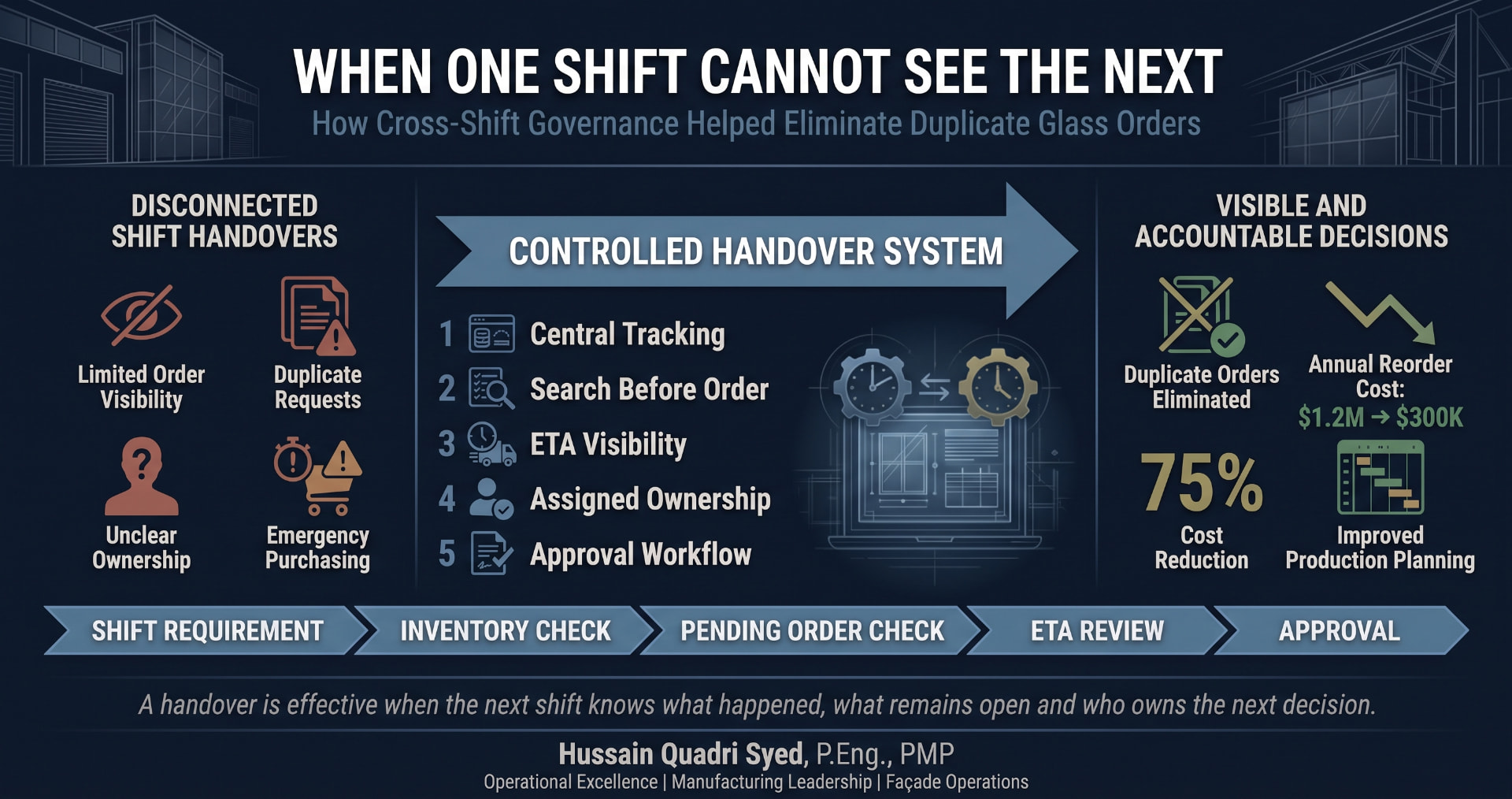
In a multi-shift manufacturing operation, each team may perform its own work correctly and the overall system can still produce an expensive mistake.
That is what happens when one shift identifies a missing material, raises a request and moves on, while the next shift sees the same shortage but cannot see that action. From the second team's perspective, placing another order may appear completely reasonable. At the system level, however, the business has paid twice to solve the same problem.
This was one of the risks within a façade-manufacturing glass-reorder process that had become costly and reactive. Annual reorder costs had reached approximately $1.2 million. The issue was not simply excessive material consumption or careless purchasing. Important information was fragmented across shifts and departments, and the process did not consistently show what had already been requested, what was in stock, what was arriving and who owned the next decision.
The improvement required more than asking employees to communicate better. It required treating the shift handover as an operational control.
This article in my From the Manufacturing Floor series explains how centralized tracking, search-before-order verification, delivery visibility, assigned ownership and authorization helped create that control.
When Every Shift Has Only Part of the Story
Manufacturing handovers often concentrate on immediate production conditions: which jobs are running, which machines are down and what the incoming team must complete. Those details matter, but material decisions can remain outside the same structured conversation.
Consider a simplified example. A shift discovers that a required glass unit is unavailable. Someone sends an email or starts a request. The employee's shift ends before the material arrives. The next team sees the same incomplete project, checks the local production area, finds no glass and submits another urgent request.
Both teams are trying to protect production. Neither has a complete view of the process.
The duplication becomes more likely when information is distributed across emails, individual spreadsheets, verbal discussions and personal memory. It becomes even harder when Production, Planning, Purchasing, Quality and Logistics each hold a different part of the status.
The resulting waste does not always appear immediately. It may surface later as excess inventory, an unnecessary invoice, special handling, a supplier dispute or another material that cannot be prioritized because funds and attention have already been consumed.
The core lesson is simple: reasonable local decisions can still create an unreasonable system result.
Why an Informal Handover Is Not Enough
Telling teams to “communicate more” rarely creates a sustainable process. Informal communication depends on who is working, what they remember and whether the next person knows where to look.
The investigation identified several connected weaknesses:
- No single record showing current inventory, previous requests and pending purchase orders
- Limited communication between shifts
- Poor visibility into supplier delivery dates and incoming shipments
- No consistent verification before another order was raised
- Informal authorization for costly or urgent requests
- Unclear ownership of open material requirements
These were not isolated administrative gaps. Together, they allowed the same shortage to be interpreted as a new problem more than once.
A reliable handover therefore needed to answer five questions:
- 1What material or project requirement is open?
- 2What has already been checked?
- 3What action has already been taken?
- 4When is the material expected?
- 5Who owns the next decision?
If the incoming shift could not answer those questions quickly, the handover was incomplete.
Creating One Shared View of the Requirement
The first major control was centralized tracking. Rather than allowing requests to remain scattered across separate messages and files, the team established one shared record for glass-reorder activity.
The record connected the requirement to the relevant project and captured the information needed for a decision, including:
- Material or glass-unit identification
- Project reference
- Quantity required
- Available inventory
- Existing request or purchase-order status
- Supplier delivery estimate
- Current owner
- Approval status
- Next action
This changed the purpose of the handover. The outgoing shift was no longer merely reporting that glass was missing. It was transferring the status of a controlled business decision.
Central visibility also improved cross-functional coordination. Production could see whether material was already incoming. Planning could adjust the sequence using a realistic delivery date. Purchasing could avoid duplicate supplier activity. Quality and Logistics could help verify whether material was available elsewhere or already moving through the system.
Introducing the Search-Before-Order Rule
Visibility is useful only when it changes behaviour. A mandatory search-before-order rule was therefore introduced.
Before submitting another request, the responsible person had to verify:
- 1
Existing inventory
Is the required material physically available or allocated elsewhere?
- 2
Pending purchase orders
Has Purchasing already placed an order?
- 3
Incoming shipments
Is the material already in transit?
- 4
Previous requests
Has another shift or department already reported the same requirement?
- 5
Project need
Is the specification and quantity still valid?
This verification converted reordering from a reaction into a controlled decision. It also made the handover actionable. The next shift did not need to repeat the entire investigation because the completed checks were visible in the shared record.
The control was intentionally practical. It did not depend on a complex digital transformation. What mattered was having one reliable source, mandatory fields and a clear rule that another order could not proceed until the existing information had been checked.
Making Delivery Dates Operationally Visible
A purchase order without an expected delivery date does not give Production enough information to plan.
When teams cannot see when material is expected, uncertainty can feel like absence. That uncertainty encourages emergency purchasing because employees try to protect the schedule with the information available to them.
Adding ETA visibility allowed planners and shift leaders to make a different decision. If the required glass was already due shortly, the team could resequence work, prepare the next operation or temporarily move resources rather than place another order.
This is an important distinction. The system was not designed simply to stop spending. It was designed to support better production decisions while controlling unnecessary spending.
Assigning Ownership and Approval
A shared tracker can still fail when everyone can see an issue but nobody clearly owns it.
Each open requirement therefore needed an accountable owner and a defined next action. The owner did not necessarily perform every task, but was responsible for ensuring that the checks, follow-up and decision were completed.
Tiered authorization added another layer of governance. Requests could be reviewed according to factors such as value, urgency and operational risk. Higher-impact exceptions received the appropriate management attention before additional cost was committed.
This prevented two common problems:
- Multiple employees independently trying to solve the same shortage
- Urgent language being used as a substitute for verification
The objective was not to slow the operation with bureaucracy. It was to place a short control at the decision point where avoidable cost could still be prevented.
The Measurable Business Result
The cross-shift handover was one part of a broader glass-reorder control system that included centralized tracking, inventory verification, ETA reporting, approval controls, audits and KPI review.
Together, these changes produced measurable results:
$1.2M → $300K
Annual glass-reorder costs reduced from approximately $1.2 million to $300,000
75%
Reduction in annual reorder costs
~$900K
Approximately $900,000 in annual savings
- Duplicate orders eliminated
- Emergency purchasing reduced
- Improved inventory utilization and production planning
The cross-shift handover was one part of a broader control system that included centralized tracking, inventory verification, ETA reporting, approval controls, audits and KPI review.
- Annual glass-reorder costs decreased from approximately $1.2 million to $300,000
- Reorder costs were reduced by 75%
- The operation realized approximately $900,000 in annual savings
- Duplicate orders were eliminated
- Emergency purchasing was reduced
- Inventory utilization improved
- Production planning became more reliable
These results should not be attributed to better handovers alone. Their importance was that handovers connected the controls across time. A verification completed on one shift remained visible and useful to the next, allowing the overall system to sustain the decision.
What Manufacturing Leaders Can Learn
Communication should be designed into the process
Critical information should not depend on whether two employees happen to speak before a shift ends. The operating system must capture and transfer it consistently.
One source of truth prevents multiple versions of the problem
When different departments use separate records, each can make a logical decision based on incomplete information. A shared view allows the organization to make one coordinated decision.
Visibility requires a reaction rule
A dashboard or tracker does not create control on its own. Employees must know what to check, what prevents release and when escalation is required.
Ownership must survive the shift change
Tasks can transfer between people, but accountability cannot disappear. Every open requirement needs a visible owner and next action.
Operational governance should make good decisions easier
The strongest controls do not merely restrict employees. They give teams the information needed to protect production without creating unnecessary cost.
From Handover to Control System
A shift handover is often treated as a brief update between outgoing and incoming teams. In a multi-shift manufacturing environment, it should be treated as something more important: a control that preserves decision continuity.
The next shift should not have to rediscover what the previous shift already learned. It should be able to see what happened, what was verified, what remains open and who owns the next decision.
When that information is combined with centralized tracking, inventory checks, delivery visibility and clear authorization, the organization becomes less dependent on memory and more capable of making consistent decisions.
The larger leadership lesson is this:
A handover is effective when the next shift knows what happened, what remains open and who owns the next decision.
Glass Reorder Cost Reduction
See the documented operational controls and measurable business results behind this leadership insight.
From the Manufacturing Floor
About the Author
Hussain Quadri Syed, P.Eng., PMP is a manufacturing operations and continuous-improvement professional with experience in façade, window-wall and architectural-aluminum manufacturing. His work spans operational excellence, production leadership, quality management, supplier improvement, cost reduction and cross-functional process control.
Explore the related Glass Reorder Cost Reduction case study and other manufacturing-improvement projects at hussainsyed.ca.
Looking for a manufacturing and operational-excellence leader who connects shop-floor execution, cross-functional governance and measurable business results?