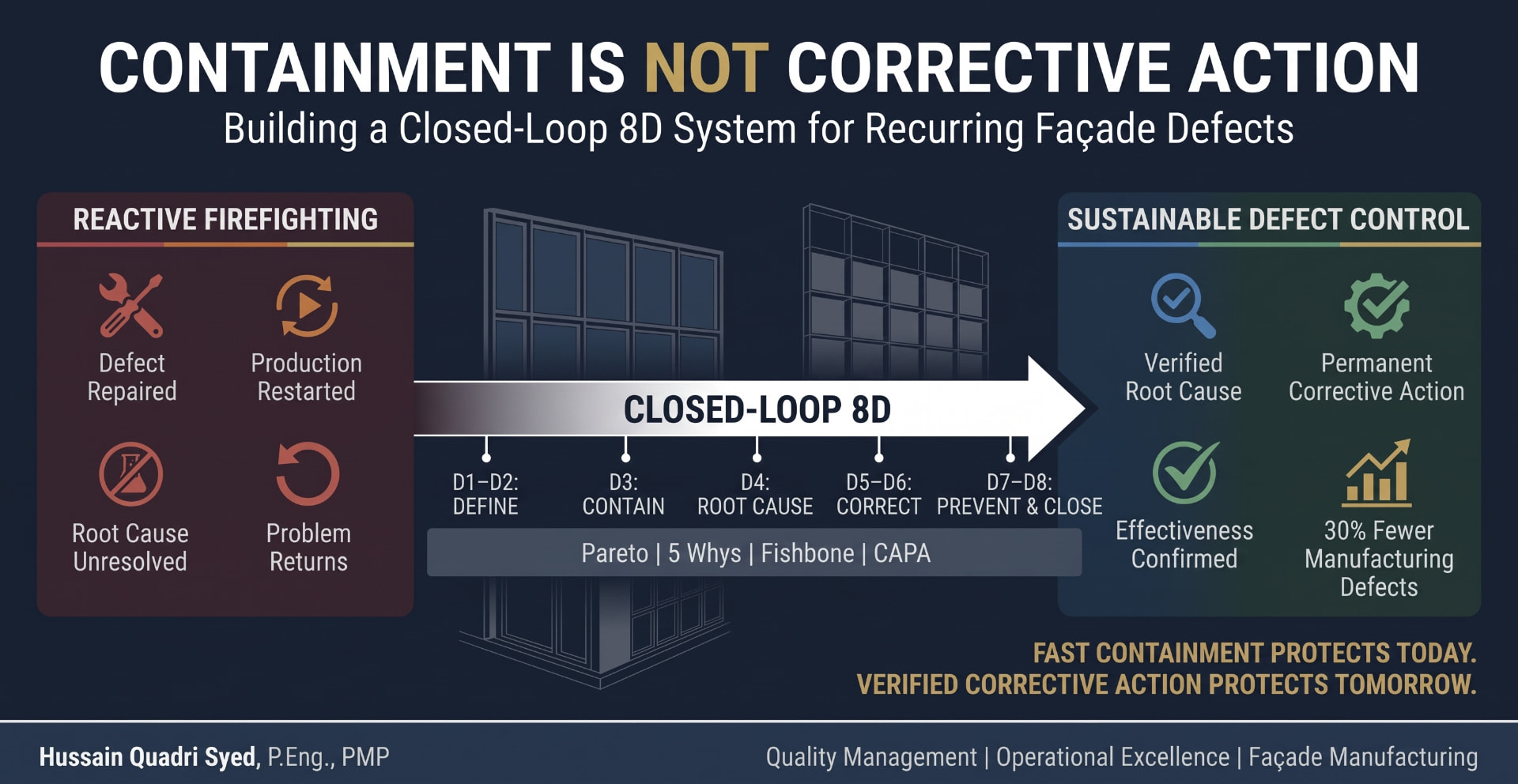
A manufacturing defect creates immediate pressure. Production may be interrupted, material may need to be isolated, and teams want the fastest possible route back to normal output.
That urgency makes containment essential. The affected units are identified, the immediate risk is controlled, and production can restart safely.
But containment does not explain why the problem occurred. It does not prove that the cause has been removed, and it does not prevent the same defect from returning on another shift, product or project.
In façade manufacturing, this distinction matters. A recurring issue can affect fabrication, assembly, finishing, inspection, shipment and site installation. If the response ends with sorting, repair or replacement, the factory may become highly efficient at managing the symptom while leaving the underlying process unchanged.
This article, the third in my From the Manufacturing Floor series, explains how a closed-loop 8D system helped move defect management from reactive firefighting to verified corrective action. The approach combined fast containment, structured investigation, cross-functional ownership, permanent action, effectiveness checks and standardization.
Why Containment Is Often Mistaken for Completion
When a defect is discovered, the first response is usually visible and immediate:
- Stop or control the affected process
- Identify potentially affected material
- Separate conforming and nonconforming units
- Repair or replace the defect
- Confirm that production can resume
- Protect the customer from receiving suspect product
These actions are necessary. They protect safety, delivery and customer requirements while the problem is being investigated.
The risk appears when an effective short-term response is treated as the final solution. Once production restarts and the schedule pressure decreases, the investigation can lose momentum. The defect record may be closed because the affected units were repaired, even though the reason for the failure remains unknown.
The operating cycle then becomes predictable:
- A defect appears.
- The team contains and repairs it.
- Production restarts.
- The root cause remains unresolved.
- The same or a related problem returns.
The organization is working hard, but its effort is being spent repeatedly on the same failure mode.
The leadership question should therefore change from:
Have we repaired the defective product?
to:
Have we removed the verified cause and demonstrated that the defect will not recur?
Converting Firefighting into a Closed-Loop System
The purpose of 8D problem solving is not to produce another form or hold another meeting. It is to create a disciplined path from problem recognition to verified closure.
For practical shop-floor use, the eight disciplines can be organized into five connected phases:
D1–D2: Define
The first step is to establish the team and describe the problem clearly.
A useful problem statement defines what happened, where it occurred, when it was detected, which product or process was affected, and how large the exposure may be. It separates evidence from assumptions.
Statements such as “operator error” or “quality issue” are not sufficient. They describe a conclusion or a category, not the actual failure condition. A strong definition gives the team a common starting point and prevents the investigation from moving toward a preferred explanation before the facts are understood.
The team should include the functions capable of explaining and changing the process. Depending on the issue, this may involve Production, Quality, Engineering, Maintenance, Planning, Purchasing or Logistics. Cross-functional participation is important because the defect may be detected in one area while its cause originates somewhere else.
D3: Contain
Containment protects the customer and the operation while the investigation continues.
The team identifies the suspected population, controls affected inventory and defines temporary inspection or process requirements. Responsibilities, timing and release authority must be clear. Temporary controls should be strong enough to manage the immediate risk, but they should also be visibly identified as temporary.
This distinction creates accountability. If additional inspection, sorting or manual verification becomes part of normal work without an end date, containment can quietly become a permanent cost.
D4: Verify the Root Cause
Root-cause analysis should identify both why the defect occurred and why the existing controls failed to detect or prevent it.
Several tools can support the investigation:
- Pareto analysis identifies the defect categories or process areas creating the greatest impact.
- 5 Whys helps trace the cause-and-effect chain beyond the first explanation.
- Fishbone analysis organizes possible causes across people, methods, machines, materials, measurement and environment.
- Gemba observation compares the documented process with the work actually being performed.
- Data review and controlled trials test whether a suspected cause can reproduce or eliminate the failure.
The critical word is verified. A possible cause becomes a root cause only when evidence demonstrates the relationship between the cause and the defect.
For example, retraining may appear to be a reasonable response when a workmanship issue is found. However, further investigation may reveal that the work instruction is unclear, the fixture allows incorrect positioning, the acceptance standard is difficult to interpret, or the inspection occurs too late. Training alone would not permanently correct any of those conditions.
Correct the Process, Not Only the Product
D5–D6: Correct and Implement
Once the root cause has been verified, the team selects a permanent corrective action and implements it under controlled conditions.
The strongest actions change the process so that the failure is prevented, made visible or detected closer to its source. Depending on the verified cause, the response may include:
- Fixture or tooling changes
- Improved process parameters
- Revised inspection points
- Clear acceptance criteria
- Mistake-proofing controls
- Updated work instructions
- Supplier corrective action
- Defined reaction plans
- Role-specific training linked to the revised standard
The corrective action should be assessed for feasibility, risk and unintended consequences before full implementation. A change that prevents one defect but creates a new constraint, safety concern or quality risk is not a successful solution.
Implementation also requires ownership. Every action needs a responsible person, a completion date and objective evidence. Without these controls, an investigation can remain open for months while temporary measures continue consuming resources.
Effectiveness Must Be Demonstrated
D7–D8: Prevent Recurrence and Close
Completing an action is not the same as proving that it worked.
Effectiveness verification should define:
- What result will demonstrate success
- Which metric or defect code will be monitored
- How long the process must remain stable
- Whether the result is consistent across products and shifts
- Who has authority to approve closure
- When temporary containment can be removed
This step prevents administrative closure from replacing operational evidence. A corrected drawing, revised procedure or completed training record confirms that an action occurred. It does not, by itself, confirm that recurrence has been prevented.
The team must observe the process after implementation and compare performance with the original problem. If the defect continues, the response returns to investigation rather than being declared successful.
Once effectiveness is confirmed, the learning should be extended where appropriate. Similar products, workstations, suppliers or facilities may share the same risk. Relevant control plans, inspection standards, work instructions, training material and audit criteria should be updated so the improvement becomes part of the operating system.
Closing the 8D also means recognizing the people who contributed. Sustainable problem solving depends on operators and supervisors being willing to report abnormalities, share evidence and participate honestly in investigations. A blame-focused process hides problems; a disciplined learning process makes them visible.
Creating Ownership across Functions
Recurring defects rarely belong to one department alone.
Quality may manage the formal investigation, but Production understands daily process behaviour. Engineering controls technical requirements. Maintenance influences equipment condition. Purchasing and Supplier Quality manage external causes. Planning determines sequencing and production pressure. Leadership controls priority and resources.
A closed-loop system connects these responsibilities through:
- One documented problem statement
- Named action owners and deadlines
- Evidence attached to each decision
- Regular review of overdue actions
- Clear escalation for high-risk or recurring issues
- Formal effectiveness approval before closure
- Communication of lessons learned to affected teams
This structure changes corrective action from a Quality department task into a shared operational responsibility.
The Measurable Result
Recurring manufacturing defects were reduced through closed-loop 8D, verified root-cause analysis, corrective action and effectiveness checks.
Recurring manufacturing defects reduced
Through closed-loop 8D, verified root-cause analysis, corrective action and effectiveness checks.
- Faster containment without confusing containment with closure
- Evidence-based root-cause verification
- Clear ownership of permanent corrective actions
- Effectiveness checks before formal closure
- Updated standards to help prevent recurrence
The result was not created by a single analytical tool. It came from improving the complete response to nonconformance:
- Containing issues quickly without confusing containment with closure
- Prioritizing recurring and high-impact defects using data
- Investigating causes across functional boundaries
- Requiring evidence before accepting a root cause
- Assigning permanent actions to accountable owners
- Verifying effectiveness before closing the record
- Updating standards so the learning remained in the process
The most important improvement was behavioural. Teams increasingly treated recurrence as evidence that the system had not yet learned enough, rather than as another isolated event to repair.
What Manufacturing and Quality Leaders Can Learn
Fast containment and thorough investigation serve different purposes
Containment protects today’s production and customer. Root-cause correction protects tomorrow’s performance. A mature quality system requires both.
A closed action is not necessarily an effective action
Completion dates and signed records measure administration. Defect performance after implementation measures effectiveness.
“Operator error” is usually the beginning of the investigation
Leaders must examine the conditions surrounding the work: instructions, tooling, materials, workload, measurement methods, training and process design.
Recurring defects reveal weaknesses in the management system
When the same issue returns, the organization should examine how problems are defined, investigated, assigned, verified and standardized.
The best corrective actions reduce dependence on memory
Mistake-proofing, clear process controls and early verification are generally more sustainable than reminders or retraining alone.
Leadership Takeaway
Fast containment protects today. Verified corrective action protects tomorrow.
In façade manufacturing, the cost of a recurring defect grows as the product moves downstream. A problem that is manageable at the workstation becomes more disruptive after assembly, shipment or installation.
The purpose of closed-loop 8D is therefore larger than defect reporting. It creates a repeatable management discipline for turning operational failures into permanent learning.
When teams define the problem clearly, protect the customer, verify the root cause, implement permanent action and confirm effectiveness, corrective action stops being paperwork. It becomes a practical system for improving quality, reliability and customer confidence.
From the Manufacturing Floor: Practical Lessons in Operational Excellence
About the Author
Hussain Quadri Syed, P.Eng., PMP is a manufacturing operations and operational-excellence professional with experience across façade systems, curtain walls, window walls, architectural aluminum, quality management and continuous improvement. His work has included 8D problem solving, root-cause analysis, CAPA, ISO 9001 quality systems, production leadership and cross-functional improvement programs.
This article is part of From the Manufacturing Floor: Practical Lessons in Operational Excellence, a series sharing real lessons from manufacturing performance, quality improvement and operational transformation.
Looking for a manufacturing and quality leader who turns recurring problems into verified, sustainable improvement?