In manufacturing, a production target can appear healthy while customer delivery performance tells a very different story.
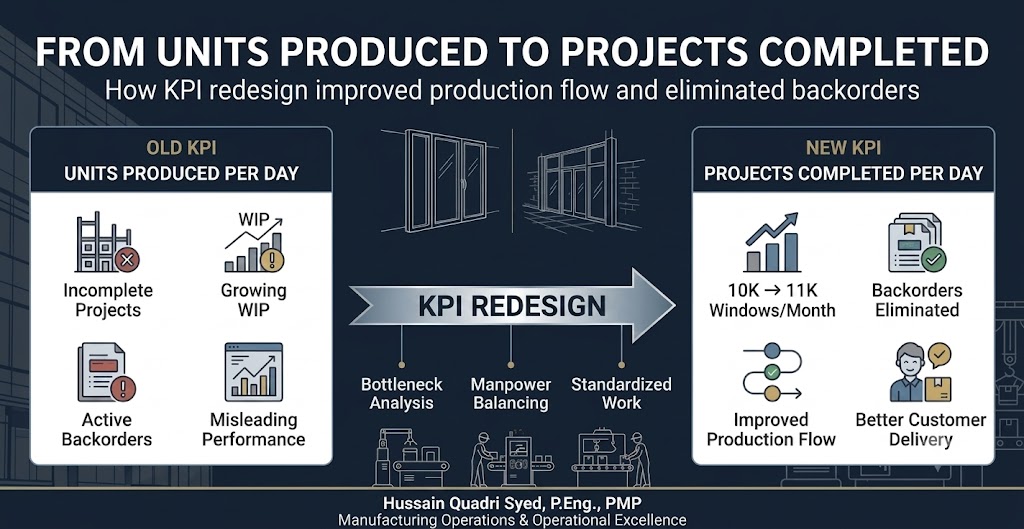
In one façade manufacturing operation, daily window output was the primary production measure. Teams could achieve their unit targets, yet some customer orders remained incomplete. Casement and awning vent assemblies were not always progressing at the same rate as the main window units. This created unfinished projects, growing work-in-process, active backorders and pressure on downstream teams.
The problem was not that employees were ignoring the target. The deeper issue was that the target rewarded activity without fully measuring customer completion.
This case reinforced an important operational-excellence principle: a KPI should reflect the value delivered to the customer, not simply the volume produced inside the factory.
When a Good Production Number Hides a Delivery Problem
“Windows produced per day” was easy to understand and track. However, it treated every completed unit as equal progress, even when the remaining components required to complete a customer project were unavailable or delayed.
As a result, the factory could report strong daily production while still carrying incomplete orders. New jobs continued entering production before earlier projects had been fully completed. That increased work-in-process, complicated prioritization and made the production number less representative of actual delivery readiness.
This was a classic example of a local metric appearing successful while the overall system remained constrained.
The question therefore changed from:
How many windows did we produce today?
to:
How many customer projects did we move to complete status today?
That distinction became the foundation of the improvement strategy.
Finding the Constraint Through Time Studies
Before changing the KPI, it was necessary to understand what was preventing projects from reaching completion.
Detailed time studies were conducted across the relevant production and sub-assembly activities. The analysis identified casement and awning vent assembly as a significant constraint. The main window units could move through production faster than these supporting components, leaving otherwise completed projects waiting for the remaining parts.
The time studies helped separate assumptions from evidence. They clarified where labour capacity was misaligned, where queues were forming and which activities were directly limiting project completion.
Rather than asking every department to work faster, the focus shifted to improving flow at the constraint.
Redesigning the Production System
The response combined production control, standardized work, resource balancing and performance-management changes.
1. Rebalancing manpower at the bottleneck
Labour was realigned toward the constrained sub-assembly activities. This helped the supporting components progress more closely with the main window-production flow.
The objective was not to maximize utilization at every individual station. It was to improve the output of the complete system.
2. Standardizing work across shifts
Standard operating procedures were strengthened across shifts to reduce variation in working methods and expectations. A shared approach made it easier to compare performance, train employees and maintain the improvement beyond a single shift or supervisor.
3. Strengthening shift-level accountability
Performance tracking was made more visible at the shift level. Teams could see whether their work was helping complete customer projects or simply increasing partially finished inventory.
This created a clearer connection between daily production decisions and the factory’s delivery commitments.
4. Controlling the release of new work
Production controls were introduced to avoid releasing jobs without the required components and capacity needed to complete them. This reduced the tendency to start additional work while existing projects were still waiting at the constraint.
5. Changing the KPI
The most important change was moving the operational focus from windows produced per day to projects completed per day.
The original unit measure did not disappear completely; unit output still provided useful capacity information. However, it was no longer treated as the best standalone indicator of production success.
Project completion became the stronger measure because it aligned production with customer delivery.
The Measurable Result
The combined changes produced a meaningful improvement in both output and flow:
- Monthly production increased from approximately 10,000 to 11,000 windows
- Active production backorders were eliminated
- Work-in-process was reduced
- Project-completion performance improved
- Production flow and delivery readiness became more visible
- Shift-level accountability and process consistency were strengthened
The improvement did not come from demanding higher effort without changing the system. It came from identifying the constraint, reallocating resources, standardizing execution and aligning the KPI with the result that mattered.
What Manufacturing Leaders Can Learn
Activity is not the same as completion
A factory can produce a large number of units and still disappoint the customer if the order cannot be completed and shipped. Operational metrics must distinguish between work performed and value delivered.
Teams optimize what leaders measure
If employees are measured only on unit count, they will naturally prioritize the activities that increase unit count. This may be rational at the department level while creating unintended consequences for the wider operation.
Bottlenecks require system-level decisions
Improving a non-constrained process may create more inventory without improving total output. Time studies and flow analysis help leadership direct resources toward the part of the system that controls completion.
KPIs should support better decisions
A useful KPI should not exist only for reporting. It should help supervisors and operators decide what to prioritize, which work to release and where intervention is required.
Sustainable improvement combines people and process
The KPI change was important, but it worked because it was supported by manpower balancing, standard work, production controls and accountability. Measurement alone does not transform performance; it must be connected to operational action.
From Shop-Floor Output to Customer Value
This project changed more than a dashboard. It changed the definition of a successful production day.
Success was no longer based only on how many units moved through individual operations. It was increasingly measured by whether customer projects reached completion without creating unnecessary work-in-process or backorders.
For manufacturing and façade operations, this distinction is especially important. A finished window, curtain-wall panel or railing component has limited customer value if other required elements are missing. Production, quality, engineering, material availability and project delivery must operate as one connected system.
The central lesson is straightforward:
A KPI should measure customer value, not simply internal activity.
When the metric reflects the true objective, teams can make better decisions, constraints become more visible and continuous improvement becomes connected to business performance.
About the Author
Hussain Quadri Syed, P.Eng., PMP is a manufacturing operations and operational-excellence leader with experience in façade systems, curtain walls, window walls, aluminum railings, quality management and continuous improvement. His work has included production leadership, bottleneck analysis, Lean manufacturing, KPI redesign, quality transformation and cross-functional improvement programs.
Explore more measurable manufacturing and façade improvement projects in the portfolio, download the latest résumé or contact Hussain to discuss opportunities in manufacturing management, operational excellence, continuous improvement and quality leadership.